Before the Penny Black,
by E and R Shanahan.
Introduction:-
The 6th May, 1990 marked the 150th anniversary of the world's first adhesive postage stamp - the 'Penny Black'.

The first 'MASTER OF THE POSTS' was Sir Brian Tuke,who held that position from 1516-1545, during the reign of King Henry the Eighth.
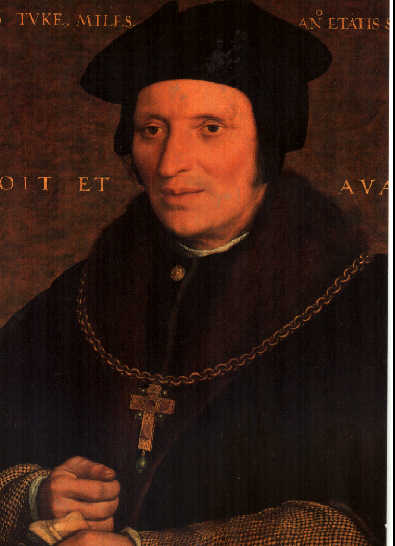
During the reign of Queen Elizabeth the First (1558-1603) there was a system of Post Roads. The messengers, or Post-boys, either went by foot, or on horse-back. A huge number of horses was involved in this operation as each stage was only about 10 miles, after which a fresh horse was used. In most cases the horses were kept at Inns or Hostelries
Originally most mail was sent by or on behalf of the Government - frequently on military matters. There would have been less private mail, as the ordinary people were more or less illiterate, and the educated nobility used their own servants to deliver local messages.
However, during the Elizabethan and subsequent periods there was much plotting and intrigue between rival rulers and their supporters. Elizabeth the First realised that if she could see the private correspondence, she could see who was plotting what ! So, if mail was handled officially, under the instructions of some Court official, it could be opened and read, unknown to the writer of the letter.

Espionage is not a new idea !
In 1635 King Charles the First (1625-1649) issued a Proclamation to say that Thomas Witherings Esquire should set up a "Running-Post" between London and Ireland. Sir Thomas had a notice printed to inform the public, and a copy of this broadsheet is held in the British Museum in London. It is dated 1635 and it lays out the route to be taken, the days on which the mails would go and return, the cost of the service and where the money was to be paid for the service.
The Proclamation stated that no other Messengers or Foot-Posts could be used other than this service to be set up by Sir Thomas.
The bottom line of the Proclamation stated that
'His Majesty straightly charged and commanded all his loving Subjects whatsoever
duly to observe his Royall pleasure therein declared, as they will answer the contrary
at their perils.'
At this time, the likely result of displeasing the ruling Monarch was imprisonment in the Tower
of London, or even execution!
It is interesting that the route actually specified the towns that would be served by the post, and these were on the map of the Elizabethan Post-roads - (see previous map)
Starting from London, the horse-post stages where letters could be collected and delivered were to be :-
St. Albans, Dunstable, Brickhill, Stony-Stratford, Daventry, Coventry, Tamworth, Lichfield, Stafford, Stone, Nantwich, Chester, Flint, Rutland, Aberconway, Beaumarice, Holy-Head and all such other places, as are upon this Road or near this Road.
Sir Thomas Witherings, at the time was 'His Majesties Post-Master for Forraigne parts', and it is obvious that he understood how to organise this inland post, as it took him only 3 months from the date of the Proclamation, to announce the date of the first mail to Ireland.
However, letters were exchanged privately, in particular within the City of London, which was the business and financial centre.
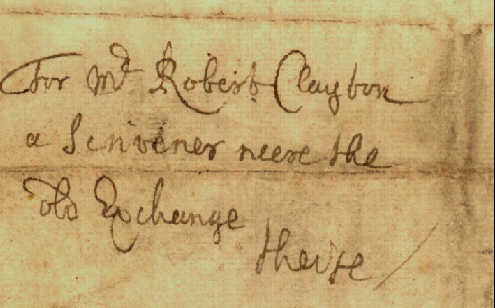
For instance, this letter written by John Heath from his office in the Inner Temple, (one of the Inns of Court in London) is dated 'Last of 10th 1660' and is addressed to 'Mr. Robert Clayton, a Scrivener Neere the old Exchange'.
"Mr. Clayton,
I have been hitherto irresolute at least, if not improvident by negligent in disposing of my
moneys, in yr hands to some better advantage, but within a day or two, when my brother & I
are somewhat better (having both at present very troublesome colds) I will advise with you,
resolve noth. myselfe about it. In the meanetime I pray deliver to bearer fifty pounds sterling,
of wch I have present use, for which this shal bee yr discharge from
Yr assured friend & servant
Jo. Heath"
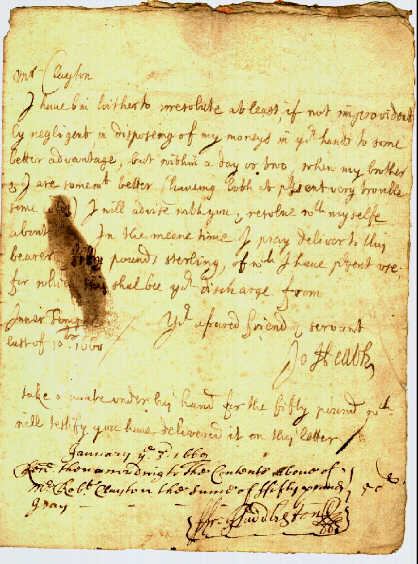
"Take a note under his hand for the fifty pound wch will testify you have delivered it on this letter."
Robert Clayton then added this note as a receipt in his own handwriting.
"January ye 3rd, 1660.
Recd. then according to contents above of Mr. Robert. Clayton sum of fifty pounds
(50)....."
This note was signed by the bearer of the note who received the money to be returned to John
Heath.
Note :- Robert Clayton was a Scrivener, and that was a writer, drafter of documents, a notary, broker, money-lender or any or all of these. In fact he became Lord Mayor of London, and was also knighted and elected as one of the Directors of the Bank of England.
Free Franks
- (Free Postage for Members of Parliament etc.)
Oliver Cromwell, who ruled England as Lord Protector from 1653-1658, was a great organiser, and
his Parliament passed an Act in 1657 which declared :-
"There shall be one General Post Office and one officer styled the Postmaster General of
England."
The Act also said that all other persons were forbidden ...
'to set up or employ any footposts, horseposts, or packet boats.'
This meant that no one else could carry the mails as a business. It also meant that it was easier to arrange a proper postal service.
A system brought into use under the Commonwealth Parliaments was Free Franks.
This was the result of a decree of the Council of State in 1652, to allow correspondence to and from Members of Parliament and certain State Officials to pass free through the post.
However, with the Restoration of the Monarchy in 1660, when King Charles the Second was re-instated as Monarch, his Parliaments did not recognise any of the laws passed by the Commonwealth or Protectorate Parliaments. So in 1660 another Act of Parliament was passed. This Act which confirmed most of the previous legislation, including the establishment of a General Post Office, under the control of one Postmaster General, is considered to be the origin of the Post Office as it is known today.
There is a written record held in England of the names of everyone who has held the office of Master of the Posts or Postmaster General, since Sir Brian Tuke in 1516. This shows how important a job it was.
The first Postmaster General was Colonel Henry Bishop, who held the position from 1660-1663.
The system of free postage, or Franking, as it was known, was confirmed under the 1660 legislation, and it remained in force until the introduction of the
Penny Post in 1840, and caused enormous losses in revenue to the Post Office and thus the Government.
Originally, the person who sent the letter only had to write the word "FREE" or "FRANK", his name, and then to affix his identifying seal, which was often the person's family Coat of Arms, on the letter with a blob of sealing wax.
As a member of the House of Lords, the Earl of Breadalbane was entitled to free franking. These two examples are of letters to and from the Earl.
The first example shows a letter addressed
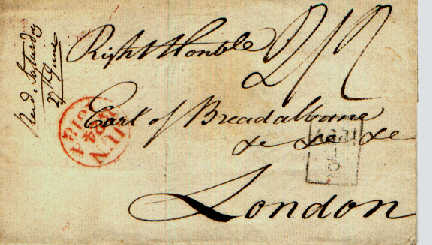 |
| Address to Earl of Beadalbane |
(The sender could not be bothered to write the complete title, or address, knowing that it would still be delivered - possibly to the House of Lords.)
The second example,
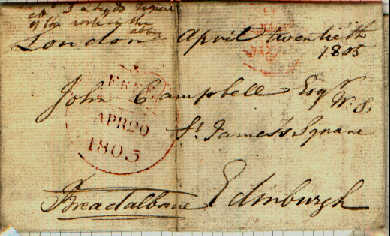
Breadalbane's 'Free Frank' |
Note also the distinctive circular FREE postmark. This type of postmark was in use on letters from 1800 to 1807.
Different types of FREE postmarks
 |
| Free Postmarksclick here for larger image |
Almost as soon as the system began, so did the cheating !
The cheating came about because, to be free from postage the letters were supposed to be on government business. All members of the House of Lords, (including the Clergy) and the House of Commons, were entitled to the privilege - but only for their own use, not for private letters.
There are many examples of such fraudulent use.For instance, letters that were obviously on private business, not government affairs.
Other examples show that a person entitled to the privilege has claimed the Free Franking by signing the letter on the front, but has not in fact written the letter.
To counteract the misuse, stricter rules were laid down, but they did not help much. A Post Office official
was not allowed to open a letter to check.
This letter dated 10th March 1760, from Carmarthen to London shows how one such abuse worked.
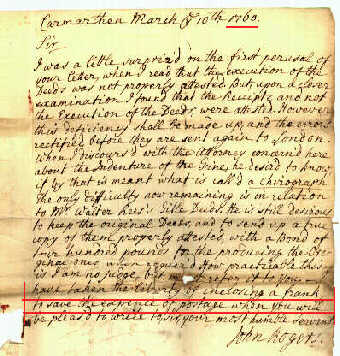
"I have taken the liberty of inclosing a frank to save the expence of postage when you will be pleas'd to write to, Sir, your most humble Servant."
Carmarthen March ye 10th, 1760
However this one to James Crowdy dated 15th February, 1820 is a correct use, as it is from the Member of Parliament to his agent in his constituency.

By this time, the laws had been changed, and to claim the free postage, the sender had to write the date in full, the post town where the letter was posted, and his full name. This was to prevent forgery. The Postmaster was supposed to know all the people in his area who were entitled to the free postage, and their handwriting. It was not easy to detect forgery if the only word written on the envelope was 'FREE'.
In fact, laws and administrative orders were added over the next 150 years or so, until in 1837, 100 out-of-date laws were replaced by five new Statutes.
Despite the amendments to the various laws relating to the cost of postage, this privilege of free postage was not cancelled until 1840, when the cheap 'Penny Postage' was introduced for everybody.
 Part Two, London Mails Part Two, London Mails
|
Part 4. Changes under way (1650 - 1850)
Part 5. Towards Penny Postage